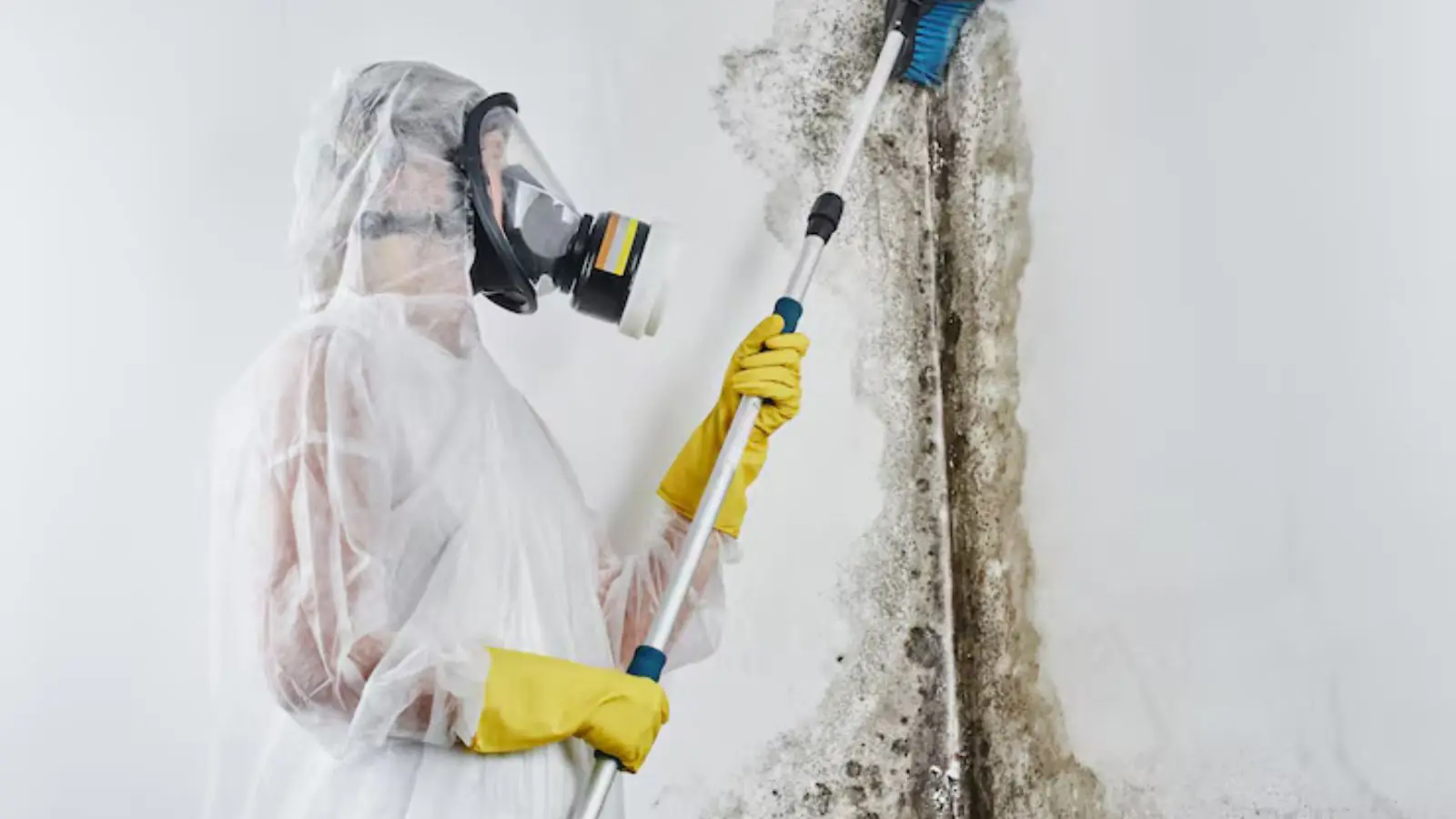
I see spots on the wall and the room smells musty: is that mold?
It might be. Dark spots in a corner, a ceiling stain that keeps growing and a damp smell are the signs people notice first. The trade name for the fix is mold remediation: containing the area, removing the growth and cleaning what is left.
Mold needs moisture to grow, so the real question is where the water is coming from. A mold job that ignores a leak behind the wall is a job that repeats itself.
What mold remediation means in Laguna Hills
Mold remediation in Laguna Hills is the process of finding the moisture source, containing the affected area, removing mold-damaged materials, cleaning surfaces and verifying the result. Crews follow the practices described in ANSI/IICRC S520, the published standard for mold remediation. Ask any company whether its crews work to it.
Typical sources here are an upstairs toilet or tub leak that drips into a ceiling below, an air handler condensate line that backs up, a roof leak after a winter storm, and a closet wall that stays damp. If water damage came first, see water mitigation for the drying step.
How remediation works
Inspect and find the moisture
Moisture meters and a thermal imaging camera locate the wet source and show how far it spread.
Fix the source
Plumbing, roof or condensate repairs happen first, by the right trade, so mold is not fed again.
Contain the area
Plastic barriers and negative air machines with HEPA filtration keep disturbed spores from spreading to the rest of the house.
Remove and clean
Mold-damaged porous materials such as drywall and carpet are removed. Hard surfaces are HEPA-vacuumed and cleaned with detergent.
Dry and verify
The area is dried to normal readings. Ask about independent clearance testing if a lender, buyer or association requires it.
Not sure it is mold?
Call and describe the spot, the smell and where the water came from.
Mold testing and inspection
People often call asking whether a stain is mold, or whether a home needs testing before a sale. A visual inspection with moisture readings is usually the first step. The California Department of Public Health states that testing for spore counts is not recommended as a first step, because cleanup decisions follow the moisture and the visible growth.
Independent clearance testing is different. It is done by a separate assessor after remediation, and it answers the question "is the area ready to close up". Buyers, lenders and associations set their own rules, so ask them what they require. We cannot promise any lender will accept a result.
Keeping the assessor and the remediator separate avoids a conflict of interest, and many homeowners prefer that.
Mold removal and black mold cleanup
Color does not tell you what kind of mold you have, and black spots are not always the species people fear. Treat any heavy growth the same way: do not scrub or sand it dry, do not use a household vacuum, and do not run fans across it.
CDPH advises that larger areas, over about 100 square feet, call for an experienced contractor, and the EPA notes that under about 10 square feet is often a homeowner job. Anything in between, or anything with hidden growth behind a wall, deserves a professional look. Health questions belong to your physician, and we do not diagnose.
Mold after water damage
The EPA advises drying water-damaged areas within 24 to 48 hours to prevent mold. After a leak, porous materials like carpet, ceiling tile and drywall often need to be removed if they stayed wet. If a room smells musty a week after a leak, mold is a reasonable concern.
Dry the area first, remove what cannot be dried, then decide whether remediation is needed. Painting over a stain does not stop growth, and the CDPH mold booklet says painting over mold lets it return.
What size job is it? A starting guide
| Affected area | Typical path | Who usually handles it |
|---|---|---|
| Under about 10 square feet, hard surface | Detergent and water, then dry | Often the homeowner, per EPA |
| 10 to 100 square feet or hidden growth | Inspection, containment, removal | A professional crew |
| Over 100 square feet | Full containment and negative air | An experienced contractor, per CDPH |
| Water, sewage or HVAC involvement | Fix the source first, then remediate | Plumber or HVAC plus a remediation crew |
This is general guidance from public health sources, not a quote. An inspection decides the actual scope.
Where mold hides in homes here
Closets and exterior walls
Furniture pushed against a cool wall limits airflow, and a closet near an upstairs bath or an air handler can stay damp for months.
Ceilings under bathrooms
A slow tub or toilet supply leak shows up as a ceiling stain in the room below long before the floor above feels wet.
Garages and crawl spaces
Most Laguna Hills homes have no basement, so lower-level mold usually means a garage, a crawl space or a retaining wall.
Behind cabinets and under sinks
A small drip stays hidden until the cabinet floor softens or the smell starts.
What affects the price of mold remediation
Area and hidden growth
Surface growth on a closet wall is smaller than growth that opened up behind drywall.
Materials involved
Porous materials are removed, so more drywall or carpet means more work.
Containment level
Bigger jobs need larger barriers and more air filtration.
Moisture source repair
The plumber or roofer is separate from the remediation scope.
Clearance testing
Independent testing, if required, is a separate cost.
The California Department of Insurance notes that flood policies usually do not cover mold that could have been avoided, and homeowners coverage for mold varies, so ask your insurer. We cannot promise a claim will be approved. Want your real number? Call dispatch and describe the area.
Hiring a mold crew, and what we do not do
Verify any contractor's license at cslb.ca.gov or by calling (800) 321-2752, and ask what mold training the crew has. California law requires a license for work worth $1,000 or more, and the down payment is capped at the lesser of 10 percent or $1,000, with a three-day right to cancel.
We do not do basement waterproofing, foundation repair or roof replacement. Those fix the cause of moisture and need other trades. We will point you to the right one when your mold is a symptom of something larger.
Moisture and mold in the Laguna Hills climate
NWS puts the water-year normal rainfall at nearby John Wayne Airport at 11.18 inches, which is dry on paper, but winter storm bursts like January 14 to 16, 2023 can test a roof in a short window. A roof or plumbing leak that goes unnoticed after a storm is one way mold gets started in a house that is otherwise dry.
If you suspect hidden moisture near the creek corridors listed in the city Safety Element, such as Aliso, Sulphur or Oso Creek, ask for moisture readings in ground-level rooms. Learn more about emergency water removal if water is still present. Nearby, we also serve Aliso Viejo and Laguna Woods.
Mold remediation FAQs
Surface growth that wipes off easily may be mildew, while growth that returns or has spread into drywall or wood is more serious. An inspection with moisture readings settles it faster than guessing.
Ask your buyer, lender or association what they require. Independent clearance testing is done by a separate assessor after remediation. We cannot promise that a lender will accept any particular result.
EPA guidance treats areas under about 10 square feet on hard surfaces as often manageable by a homeowner. Larger areas, hidden growth or growth tied to sewage or flooding should be handled by a professional.
CDPH says 10 percent bleach can be used only after cleaning, with about 10 minutes of contact, and never with ammonia. The EPA does not recommend routine biocide use. Porous materials generally cannot be cleaned and are discarded.
No. The CDPH mold booklet says painting over mold lets it return. The moisture source has to be fixed and the growth removed first.
Mold is rarely a nighttime emergency, but the 24/7 line is open. A crew is sent the same day when one is available, and the scope and price are explained before work begins.