The direct answer
This page cannot tell you whether the mold in your home is harmful to you. That question belongs to a physician. What it can do is pass along what the California Department of Public Health says and show you what to do next.
The CDPH identifies people with asthma, weakened immune systems, infants and older adults as higher-risk groups. Its Mold Booklet links indoor mold to asthma attacks, new asthma, bronchitis and eczema. If anyone in your home fits those groups, call your doctor and treat the cleanup as a priority.
What a ceiling spot usually means
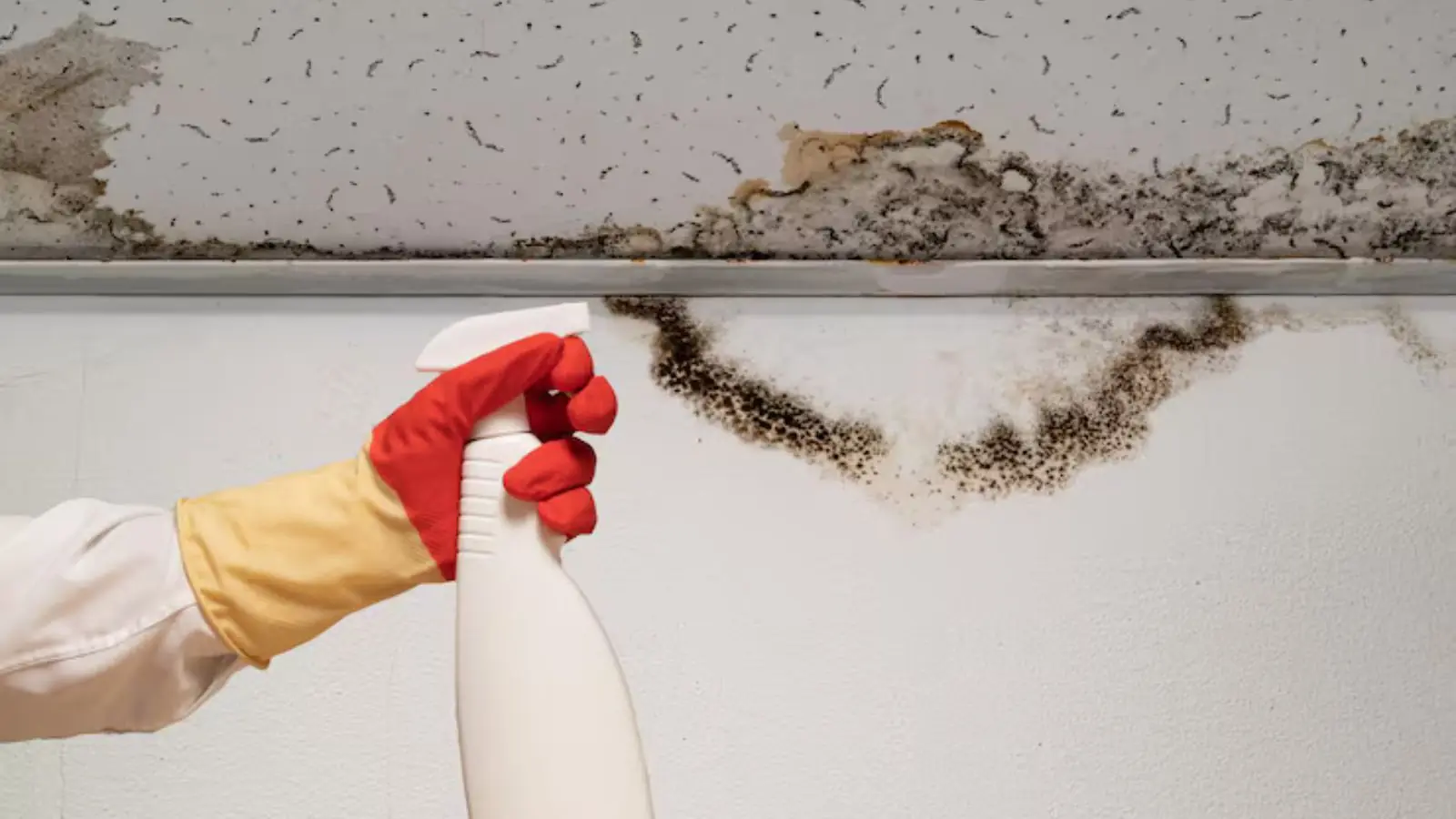
Mold needs moisture and something organic to grow on, and ceiling drywall and paper facing supply both. A dark spot up there nearly always means water got to the ceiling from somewhere.
The usual suspects are a roof leak, a bathroom above, an air handler condensate line or a vent fan that dumps humid air into the attic. A thermal imaging camera and a moisture meter can show whether the area is wet right now or only stained from an old event.
A dry stain with no growth is old news. Soft drywall, a musty smell or spots that spread point to moisture still arriving.
Dark spots spreading?
A growing patch means moisture is still arriving. Call the 24/7 line before you scrub or paint.
Wet, damp or old: reading the spot
| What you see | Likely meaning | Next move |
|---|---|---|
| Brown ring, dry and firm, no spotting | Past leak that has stopped | Photograph it, confirm with a moisture meter, repair and prime |
| Dark spots on a firm ceiling | Surface growth, moisture present at some point | Find the source, then clean or replace per the CDPH three steps |
| Soft, sagging or bubbling drywall | Active water inside the cavity | Call now and protect the room below |
| Spots plus musty smell near a bathroom | Humidity or a hidden leak above | Check the fan, supply lines and tub seals |
| Spotting that returns after cleaning | Source never fixed | Stop cleaning and trace the water |
Do not poke a sagging ceiling over furniture or people. A saturated section can release water and debris at once.
What to do in the first hour
Keep people out from under it
Move children, pets and anyone in a higher-risk group out of the room, especially if the drywall is sagging.
Stop the water you can
Shut off the supply to the bathroom above if a fixture is leaking. For a roof leak, set a bucket and move furniture, then call for a roofer once rain stops.
Do not paint over it
The CDPH Mold Booklet says painting over mold lets it return. Cover-ups also hide the wet drywall behind.
Do not start with a spore test
The CDPH says spore-count testing is not a first step. A visible spot already tells you moisture and growth are there.
Photograph and call
Take dated photos from several angles for your records and your insurer, then call the 24/7 line so a crew can read moisture levels.
What a crew does and what stays your call
A crew first confirms the moisture source is fixed or being fixed. They then set containment with plastic sheeting, run a negative air machine and HEPA air scrubber, and cut out wet or growth-covered drywall. That sequence is the core of professional mold remediation.
Drywall and insulation that stayed wet more than 72 hours are generally removed, and the EPA notes ceiling tiles and carpet may need to be thrown away. Replacement drywall, taping and paint fall under water damage repair, which comes after the area reads dry.
Ask any company whether its crews work to the published ANSI/IICRC S520 standard for mold. Ask for the plan in writing, including which rooms get containment and how the crew will confirm the area is dry before anything is closed up.
We do not diagnose health conditions or say what a specific spot means for your body. Ask a physician about symptoms.
Cleaning a small patch versus replacing the board
If the spot is small, firm and dry, and the source is fixed, the CDPH steps allow cleaning. Scrub with a non-ammonia detergent in hot water, wipe it dry and keep the room ventilated unless more than 48 hours have passed since any flooding, when the CDPH says not to run fans.
Ceiling drywall is porous. If the paper face is crumbling, stained through or soft, replacing that section is cleaner than trying to scrub it. Cut back to dry, solid board and look at the framing and insulation above before closing it again.
Wear an N95 respirator, gloves and goggles, and lay plastic under the work area. Anyone in a CDPH higher-risk group should stay out of the room while the work is done.
Laguna Hills: storms, roofs and the ceiling below
Roof leaks are the usual source above a ceiling stain here. The National Weather Service recorded rain waves on January 14 to 16, 2023 that caused significant flooding across San Diego, Orange and Riverside Counties, and a storm like that tests every flashing and shingle. After any heavy rain, walk your upstairs rooms and look up.
The NWS water-year normal at John Wayne Airport, a nearby station, is 11.18 inches. With rain that limited, a slow roof leak can sit unnoticed between storms. Check ceilings and attic access after the first winter rain and again after the next one.
Your practical next steps
Fix the source, dry the area, then clean or remove what is affected. If your home is in Aliso Viejo or Laguna Woods rather than Laguna Hills proper, dispatch covers those towns too.
Verify the license of anyone you hire at cslb.ca.gov, and ask what mold training the crew has. Call (949) 670-0939 for dispatch any hour.
Ceiling mold questions
Only a physician can answer that for you. The CDPH links indoor mold to asthma attacks, new asthma, bronchitis and eczema, and names asthma, weakened immune systems, infants and older adults as higher-risk groups. Ask your doctor about symptoms.
Color does not tell you what is growing or what it means for anyone. Treat any growth the same way: fix the moisture, then clean or remove the material. A physician can address health concerns.
The CDPH says spore-count testing is not a first step. Finding the water source and fixing it matters more.
No. The CDPH Mold Booklet says painting over mold lets it return. Fix the water, clean or remove the growth, dry the area, then paint.
The EPA says under about 10 square feet is often a homeowner job, but a ceiling spot usually means a leak above, and wet drywall may need removal. Larger growth needs professional guidance.
Roof leaks are the usual source above a ceiling. The NWS recorded significant flooding rains on January 14 to 16, 2023 across Orange County and nearby counties. Inspect upstairs rooms and the attic after heavy rain.