The short answer
For a minor leak, 1 to 3 days of active drying is typical. That is an industry rule of thumb, not a standard. Larger losses, hidden water in walls, or wet subfloors can run longer.
The more important number is 24 to 48 hours. The EPA says to dry water-damaged areas and items within that window to prevent mold, and mold can begin to grow in that same period. Start drying first, then sort out the schedule.
What extends drying time
| Factor | Effect on drying | What helps |
|---|---|---|
| Water category | Gray or black water means removal of materials first | Extraction and removal before drying equipment |
| Hidden water in walls and under floors | Surface looks dry while framing stays wet | Thermal imaging camera, moisture meters, small drill holes |
| Dense materials | Hardwood, plaster and concrete release water slowly | Longer run time and controlled airflow |
| Insulation and carpet pad | Hold water against framing | Removal rather than drying in place |
| High indoor humidity | Air cannot absorb more moisture | LGR dehumidifiers and a closed building |
| Open doors and windows | Wet outside air rewets materials | Close up and let dehumidifiers run |
| Late start | Water spreads and soaks deeper | Calling right away |
| Amount of water and area | More square footage, more equipment | Right-sized air mover and dehumidifier count |
Drywall and insulation that stay wet beyond 72 hours are generally removed instead of dried.
Water still in the house?
The drying clock is running. Call (949) 670-0939, any hour.
What happens on each day
Day 0: water removal
Extraction units pull standing water, and the crew maps the damage with moisture meters and a thermal imaging camera.
Day 1: set equipment
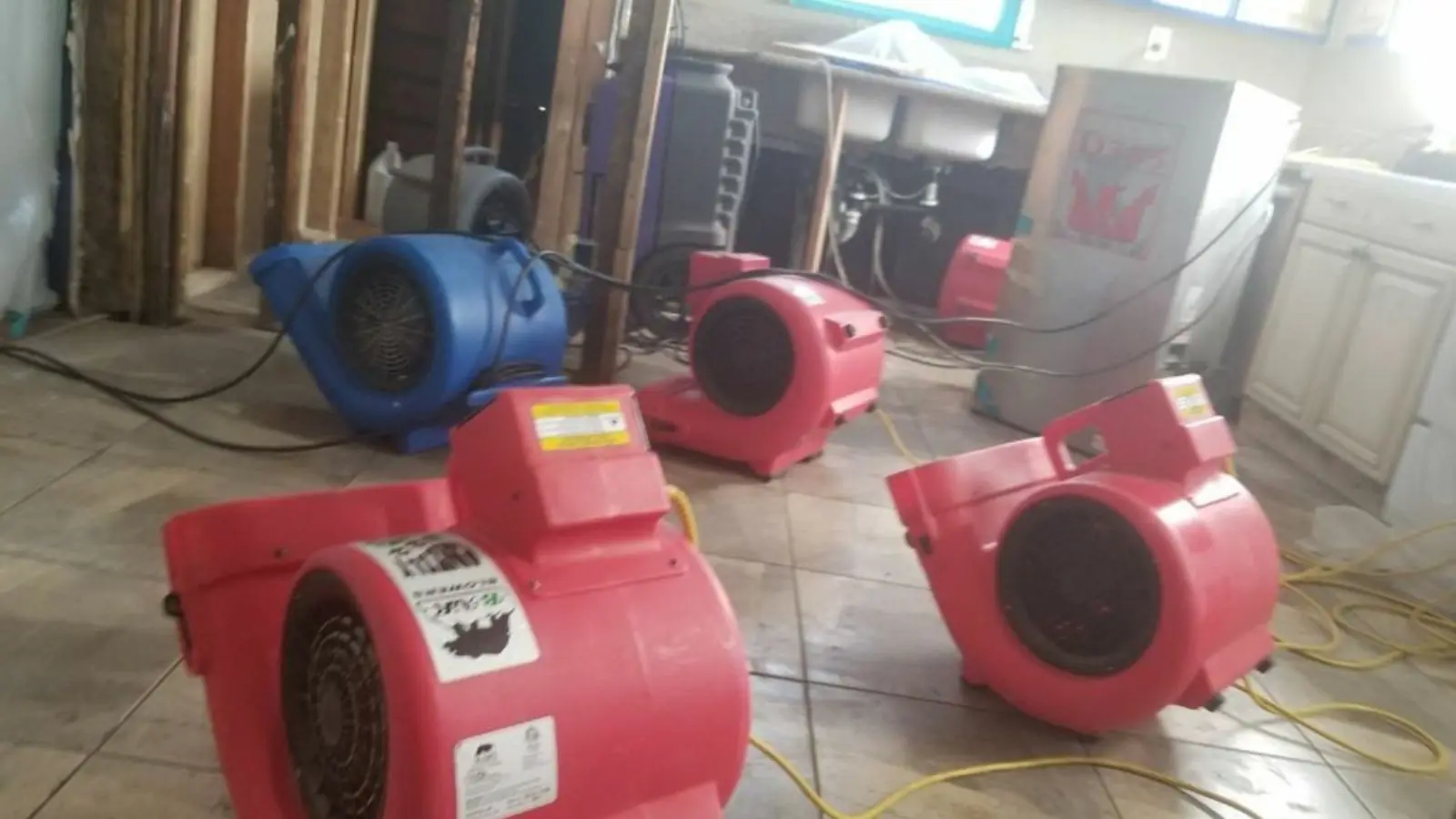
Air movers go on the wet surfaces and LGR dehumidifiers run in a closed room. Wet carpet pad, insulation and soft drywall come out.
Day 2 to 3: monitor
The crew returns daily, reads the same spots and moves or removes equipment as readings fall.
Longer jobs
Deep framing, subfloors or hardwood may need several more visits, with readings logged each time.
Finish
When every location matches the dry reference reading, equipment comes out and repair starts.
Why the equipment runs so long
Air movers
They push dry air across wet surfaces and lift moisture off the material. They are placed low along walls and across floors, not aimed at one spot.
LGR dehumidifiers
They pull the moisture out of the air so it cannot settle back. A closed room lets them work against a smaller volume of air.
Heat and airflow control
Warm, moving, dry air dries faster, but dense materials such as hardwood need gentler, slower treatment.
Daily readings
Meters tell the crew which spots lag, so equipment is moved to the slow areas instead of left in the dry ones.
What a homeowner can do while it dries
- Keep the equipment plugged in and the doors and windows closed unless the crew says otherwise.
- Do not turn off the dehumidifier to save noise. The loud hours are what finish the job.
- Move small items and furniture to dry areas, and keep children and pets away from wet areas.
- Ask for the daily readings and write them down.
- Hold off on paint, new flooring and baseboards until the crew signs off.
- Wait for the adjuster before permanent repairs, and keep receipts and photos.
How to know the house is actually dry
Ask the crew what reading ends the job. A good answer names a target based on a dry reference reading from an unaffected part of the home, taken on the same material.
Dry to the touch is not dry. Wood, drywall and concrete can feel fine while meters read high behind the surface. If you are told it is done, ask to see the log, and ask whether the crew works to ANSI/IICRC S500, the published standard for water damage restoration. Our water mitigation crews give you the readings in writing. If mold shows up anyway, mold remediation is a separate stage and a separate scope.
Winter storm drying in Laguna Hills
The National Weather Service puts the water-year normal at 11.18 inches at John Wayne Airport, a nearby station. Winter storms bring that moisture in bursts, and wet outside air can slow indoor drying when doors and windows stay open. Close up the house and let dehumidifiers handle the work.
The key is to ask what reading ends the job before the equipment is turned on. Write the number down. When the crew returns on day two, compare it to what they measured, and ask for the dry reference.
If you live next door, the same timelines apply in Laguna Woods and Laguna Niguel, where dispatch also sends crews.
Next steps
Photograph the damage, stop the source and call (949) 670-0939. Ask what reading ends the job and how many visits are planned. Dispatch is 24/7.
Drying time questions
A minor leak typically needs 1 to 3 days of active drying. That is a rule of thumb, not a standard. Larger losses take longer, and the readings decide when to stop.
Mold can begin in 24 to 48 hours when materials stay wet. The EPA advises drying water-damaged areas and items within 24 to 48 hours, and says moisture control is the key to mold control.
Not necessarily. Moisture can remain in drywall, wood and concrete beneath the surface. Meters and a thermal imaging camera show what the touch cannot.
Usually not. Wet outside air can rewet surfaces, and fans on hardwood are not recommended. A closed room with LGR dehumidifiers and air movers is the usual approach.
Drywall and insulation wet for more than 72 hours are generally removed. Tell the crew when the leak started so they can decide between drying and replacing.
Yes, during winter storms. The NWS water-year normal is 11.18 inches at John Wayne Airport. Wet outdoor air can slow indoor drying, so keep doors and windows closed and ask about dehumidification.