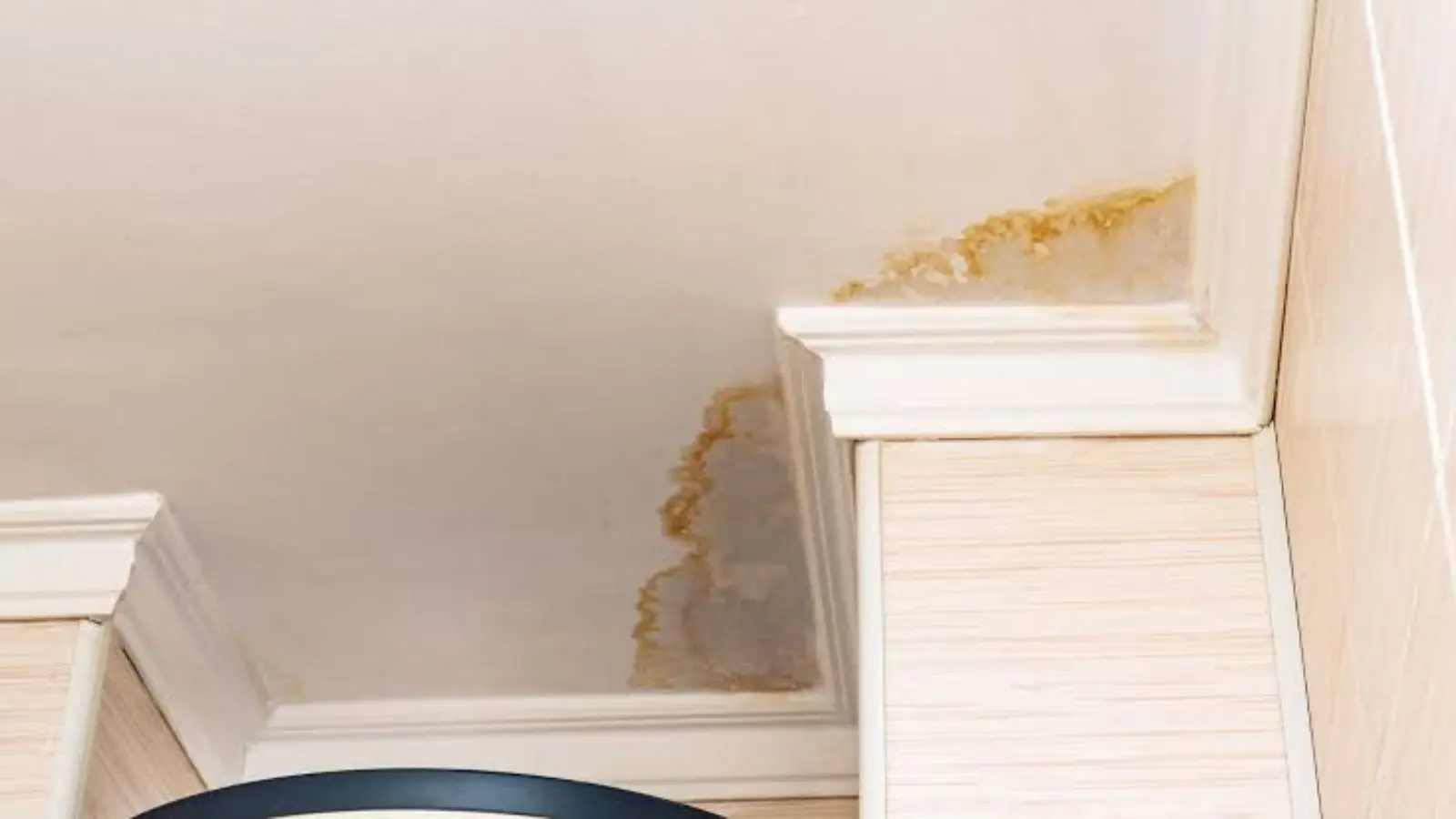
Is the stain old or still active?
Press a gloved fingertip on the edge of the stain. A dry, firm, tan or yellow ring that has not changed in weeks is probably an old leak that stopped. A cool, soft, darker or spreading spot means water is still arriving.
Mark the outer edge with a pencil and the date, then check again in a few hours. If the line moved, treat it as active and move to the shutoff steps below. If it did not move, you still need to find out what caused it, because a stain that dried can return the next time the pipe or roof is stressed.
Symptoms, likely sources and who to call
Use the pattern of the stain to guess where the water starts.
| Symptom | Likely source | Who to call |
|---|---|---|
| Stain under a bathroom or laundry room | Supply line, drain, shower pan or toilet seal | Plumber, then a drying crew if wet |
| Round ring that grows only when it rains | Roof penetration, flashing or damaged shingles | Roofer, then a drying crew if wet |
| Stain near a vent or an air handler | Clogged condensate drain line on the air conditioner | HVAC technician |
| Line of drips along a wall seam | Slow leak in a pipe running through the cavity | Plumber |
| Stain with sagging, bulging or dripping | Large volume of trapped water | Call 911 if near live wiring, otherwise a crew right away |
| Brown spots with musty smell | Long-term moisture and possible growth | Drying crew, and a mold professional if growth is present |
| Stain on an upper-floor unit ceiling | Neighbor's plumbing or roof drain | Property manager or HOA, then a crew |
A plumber and a roofer fix the leak. They do not usually dry the structure, which is where water mitigation comes in.
Stain growing or dripping?
An active leak is an emergency. Call (949) 670-0939, any hour.
Common causes behind the stain
Plumbing above the ceiling
Supply lines, drain connections and shower valves leak slowly at first. The first sign is often a faint ring that darkens each time the fixture is used.
Roof penetrations
Vent pipes, chimneys and skylights are common entry points. Water often travels along a rafter before it shows up, so the stain can sit several feet from the actual hole.
Air conditioning condensate
A clogged drain line sends cold condensation into the pan and over the edge. The stain tends to appear below the air handler in a hall or closet ceiling.
Condensation and ice
Warm air meeting cold metal ducts can drip. That is usually a lighter, repeated stain and often a sign the insulation needs attention.
What to do right now
Protect people and power
If the ceiling bulges or the light fixture is wet, switch off the breaker for that room. A dry panel is the only safe place to flip a switch. Otherwise call 911 or the utility.
Stop the supply
Close the fixture shutoff for a suspected plumbing leak, or the main valve if you cannot tell. Turn off the air conditioner if the stain sits below the air handler.
Relieve a bulge carefully
Poke a small hole at the lowest point, standing to the side, with a bucket under it. Water trapped in drywall is heavy.
Photograph and write it down
Take pictures from several angles, log the time, and keep receipts. This helps with any claim.
Call the right trade
Use the table above. If water spread to carpet, walls or insulation, call a drying crew as well, since wet drywall and insulation past 72 hours are generally removed.
When a stain means mold, not just water
Mold needs moisture. A ceiling stain that stays damp for more than 24 to 48 hours can start growing it, which is why the EPA advises drying water-damaged areas within that window. Dark speckles, a musty smell or fuzzy patches mean the cavity is probably still wet.
Do not scrub or spray a large patch yourself. Under about 10 square feet is often a homeowner job, and larger areas call for professional guidance. If anyone in the home has asthma or a weakened immune system, bring health questions to a physician. Our emergency water removal crews cover the water side, and a mold professional covers growth.
Rain, roofs and shared walls in Laguna Hills
The National Weather Service puts the water-year rainfall normal at 11.18 inches at John Wayne Airport, a nearby station, so a single storm can deliver a big share of the year in a day or two.
The January 14 to 16, 2023 rain waves caused significant flooding across San Diego, Orange and Riverside Counties. If a ceiling stain shows up after a storm, check the roof and attic first and photograph it with a date, since roofers and carriers will both ask.
In condos, townhomes and other shared buildings, a ceiling leak may start in someone else's unit. Tell your neighbor and your association or property manager as soon as you see it, in writing if possible, and ask who handles the shared plumbing and roof. Check your own policy and the association's rules before you start repairs.
Dispatch also covers neighboring Aliso Viejo and Laguna Woods, if the leak is across the line.
Next steps
Stop the water, photograph the stain and call the trade the table points to. If drywall, insulation or flooring is wet, call (949) 670-0939 for a drying crew. Dispatch is 24/7 and sends licensed and insured crews.
For general guidance on moisture and mold in homes, the EPA publishes a free guide titled A Brief Guide to Mold, Moisture, and Your Home. It is a useful neutral read before you decide how much of the ceiling to open.
Ceiling stain questions
If it is growing, soft, bulging or dripping, yes. Shut off the water supply, switch off power to the room if it is safe, and call. A dry stain that has not changed is less urgent, but it still needs a cause.
A plumber for pipes, a roofer for roof leaks, an HVAC technician for condensate, and a drying crew once materials are wet. If you cannot tell the source, a drying crew with moisture meters and a thermal camera can help trace it.
Not until the source is fixed and the area is dry. Paint hides the mark and does not stop the leak, and damp drywall behind it can grow mold.
Roof leaks grow during or after rain. Plumbing leaks grow when fixtures run or pipes are pressurized, and they often keep going in dry weather. A moisture meter and an attic look sort it out.
Tell your neighbor and your association or property manager, in writing, with dated photos. Ask who handles shared plumbing, then check your own policy. Your own drying should not wait on the dispute.
Winter storms test roofs. The NWS water-year normal is 11.18 inches at John Wayne Airport, so heavy rain can arrive in a few days. Check your roof and attic after a storm and photograph any stain.