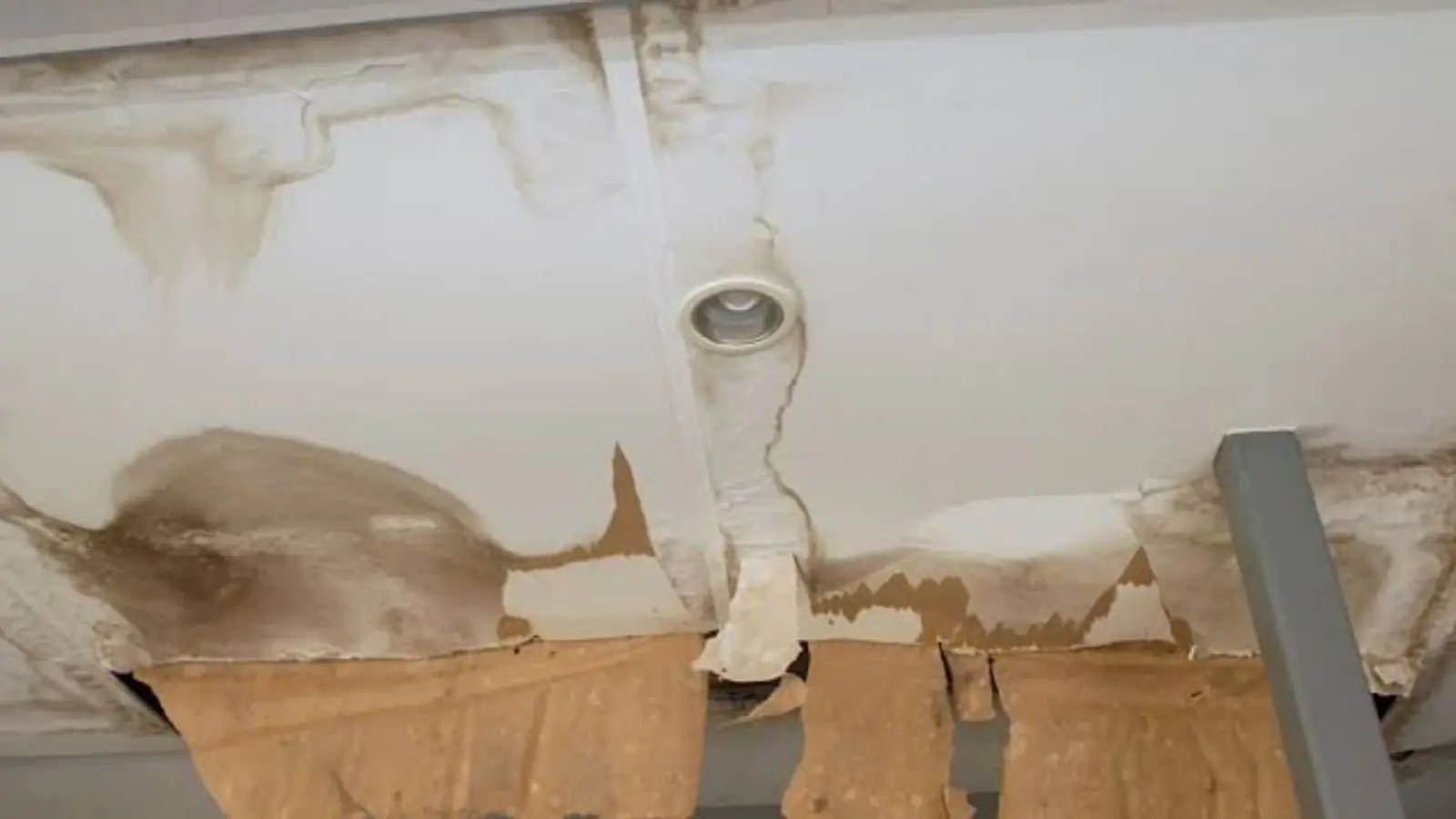
The short answer: fix the water, then the drywall
Ceiling water damage repair follows one order. Stop the leak, let the ceiling cavity dry completely, cut out the drywall that is soft or sagging, install new board, then tape, texture, prime and paint.
Paint comes last, never first. A stain painted over a wet ceiling comes back through the finish, and the damp board behind it keeps feeding mold. The EPA says wet materials should be dried within 24 to 48 hours, so the clock starts the moment you see the stain.
What to do in the first hour
Do these before anyone talks about repair.
- Turn off the water at the fixture shutoff or the main valve if the leak is plumbing. For a roof leak, set a bucket and move on to the next step.
- Switch off the breaker for any room with a dripping light fixture or a wet ceiling. If the panel is wet or you are unsure, stay out and call 911 or the utility.
- Poke a small drain hole in the lowest point of a bulging ceiling with a screwdriver, standing to the side, with a bucket below. Trapped water is heavy and can bring the board down.
- Move furniture and rugs out from under the stain, then photograph everything before touching it.
- Keep children and pets out of the room until the ceiling is checked.
Sagging or dripping ceiling?
Call (949) 670-0939 and describe what you see. Dispatch is open 24/7.
Repair sequence, step by step
Find and stop the source
A supply line, a shower pan, an air conditioner drain or a roof penetration each needs a different fix. Until it is repaired, nothing below it will stay dry.
Open the ceiling to see the damage
A crew uses a moisture meter and a thermal imaging camera to map the wet area, then cuts a hole to look at the insulation and framing above.
Remove wet insulation and ruined board
Soft, stained or sagging drywall comes out, along with saturated insulation. Cuts follow the joists so the new piece has something solid to screw into.
Dry the cavity
Air movers and a dehumidifier run until meter readings on the framing match a dry reference reading from an unaffected part of the house.
Hang, tape and texture
New drywall goes up, joints are taped and mudded in thin coats, and the texture is sprayed or hand-applied to blend with the old ceiling.
Prime and paint
A stain-blocking primer seals any leftover marks. The finish coat is rolled across the whole ceiling plane, not just the patch, so the sheen matches.
Repair or replace: how to decide
What you see on the ceiling points to how much of it has to come out.
| What you see | Usual result | Why |
|---|---|---|
| Small, dry, tan stain with firm drywall | Seal, prime and paint after the source is fixed | Board is intact and meters read dry |
| Stain with peeling paint or bubbles | Cut out the affected section | Paper face has let go of the gypsum |
| Soft, sagging or bulging area | Remove the whole section | Saturated board loses strength and can fall |
| Wet insulation above the stain | Remove and replace insulation | It holds moisture against the framing |
| Dark spots or a musty smell | Stop and call a crew | Growth may be inside the cavity |
| Stain that returns after painting | Reopen and find the source | The leak is still active |
Wet drywall and insulation that stay wet beyond 72 hours are generally removed. Ceiling tiles and similar porous materials may need to be thrown away, per the EPA.
What a homeowner can do and what needs a crew
A small, dry stain under 10 square feet with firm drywall is often a weekend job. Cut out any soft spot, let the area dry with a fan, patch, prime with a stain-blocking primer and repaint the ceiling.
Call a crew when the ceiling sags, when water came from a bathroom above (that can mean gray water), when the stain has spread past a few feet, or when you see fuzzy growth. Our water damage repair crews handle the rebuild, and they work after water mitigation has dried the structure.
We do not handle roof repair or plumbing fixes. Dispatch can describe what the drying and rebuild crew needs the plumber or roofer to finish first.
Matching texture and paint
The patch is easy. Hiding it is the hard part.
Texture types
Knockdown, orange peel, popcorn and smooth finishes each need a different spray or trowel technique. A crew tests on scrap board first.
Primer
Oil-based or shellac stain blockers seal tannin and rust marks. Ordinary wall paint alone often lets them bleed through.
Paint the full plane
Rolling the finish from wall to wall avoids a visible rectangle where the patch sits.
Popcorn ceilings
Older sprayed texture is difficult to match, and some crews prefer to retexture the full ceiling instead of patching.
Ceiling repair in Laguna Hills
Laguna Hills sits on land that was the Moulton Ranch until it was subdivided in the early 1960s. Many homes from that era still have their original ceiling textures, and those are hard to match with a small patch. Ask the crew up front whether the plan is a blended patch or a full-ceiling retexture, and who pays for the extra coat of paint.
Permits depend on the job. Building and Safety at the Civic Center, 24035 El Toro Road, handles them at (949) 707-2600, and applications go through an online portal. The city publishes no rule specific to water damage repair, so permit rules vary by scope. A single patch rarely differs from a bigger rebuild until structure or electrical work is involved, so ask the city before you sign a contract.
If you live next door in another town, our pages for Mission Viejo and Lake Forest explain how dispatch covers those areas.
Next steps
Take photos of the stain now and again after it is opened. Keep receipts for buckets, fans and plumber visits, and read your policy before you start permanent repairs.
If the ceiling is sagging, wet or growing something, call (949) 670-0939. Dispatch runs 24/7 and sends a licensed and insured crew, with same-day response when available.
Ceiling repair questions
Only after the source is fixed and the ceiling is fully dry. Use a stain-blocking primer first. Painting over a damp stain hides the problem, and moisture trapped behind it can feed mold.
A small dry-out often takes 1 to 3 days, which is a typical range and not a standard. Hidden wet insulation or a bigger loss takes longer. The crew should read moisture meters on the framing before closing anything up.
Usually not. Crews cut out the wet or sagging section, back to firm drywall, and patch it. The whole ceiling is only replaced when the damage is widespread or the texture cannot be matched.
A small dry stain, under about 10 square feet, is often a homeowner job. A sagging ceiling, bathroom water from above, or visible growth is better left to a crew with the right gear.
It depends on scope. Call Laguna Hills Building and Safety at (949) 707-2600 and describe the work. Also remember that CSLB requires a license for work worth $1,000 or more in labor and materials.